Paper 01 · September 2026
Retrieval-grounded, adapter-tuned language models for regulated finance: a map of the 2021–2026 literature
JDM Inc · Research
We assembled 8,532 papers published between 2021 and September 2026 across four layers — retrieval grounding, parameter-efficient adaptation, verification and abstention, and the financial-regulatory application domain — clustered them into twenty themes, and measured what the resulting niche actually evaluates.
8,532
papers clustered
20
themes
6,114
in-corpus citation edges
456
papers labelled by what they measure
Method
Twenty-two phrase queries against the Semantic Scholar bulk search API with Crossref as a second source, year-filtered to 2021–2026. A record joins the corpus only if it matches an NLP anchor pattern and at least one of twelve topical gates. Deduplication by DOI, then arXiv id, then normalised title. TF-IDF into truncated SVD into k-means, with k chosen by silhouette; t-SNE is used for the layout only, never for the clustering. Reference lists were then reduced to the induced subgraph, keeping an edge only where both papers are in the corpus.

Figure 1. Twenty themes across the 2021–2026 corpus. Blue marks the retrieval-grounded, adapter-tuned, regulated-finance stack; grey marks adjacent application domains that share the same methods.
Finding 1 — attention has moved from foundations to engineering
The two flattest themes are RAG foundations and low-rank-adaptation theory, both at about 1.5× their 2024 publication rate. The canonical literature is written. The fastest-growing are retrieval engineering and agentic orchestration. The question the field is working on has moved from whether retrieval helps to how the pipeline is built, tuned and audited.

Figure 2. 2026 annualised publication rate against 2024, log scale. Growth multiples computed on small 2024 bases — hybrid retrieval and agents in particular — carry wide uncertainty and should be read as ranking, not magnitude.
Finding 2 — the finance literatures are near-closed loops
Across the four finance themes, only 102 of 769 in-corpus citations — 13% — reach the retrieval, grounding, adaptation or evaluation work their systems are built on. Traffic the other way is comparably thin. The engineering layer is the mirror image: it imports heavily from foundational work and barely cites itself.
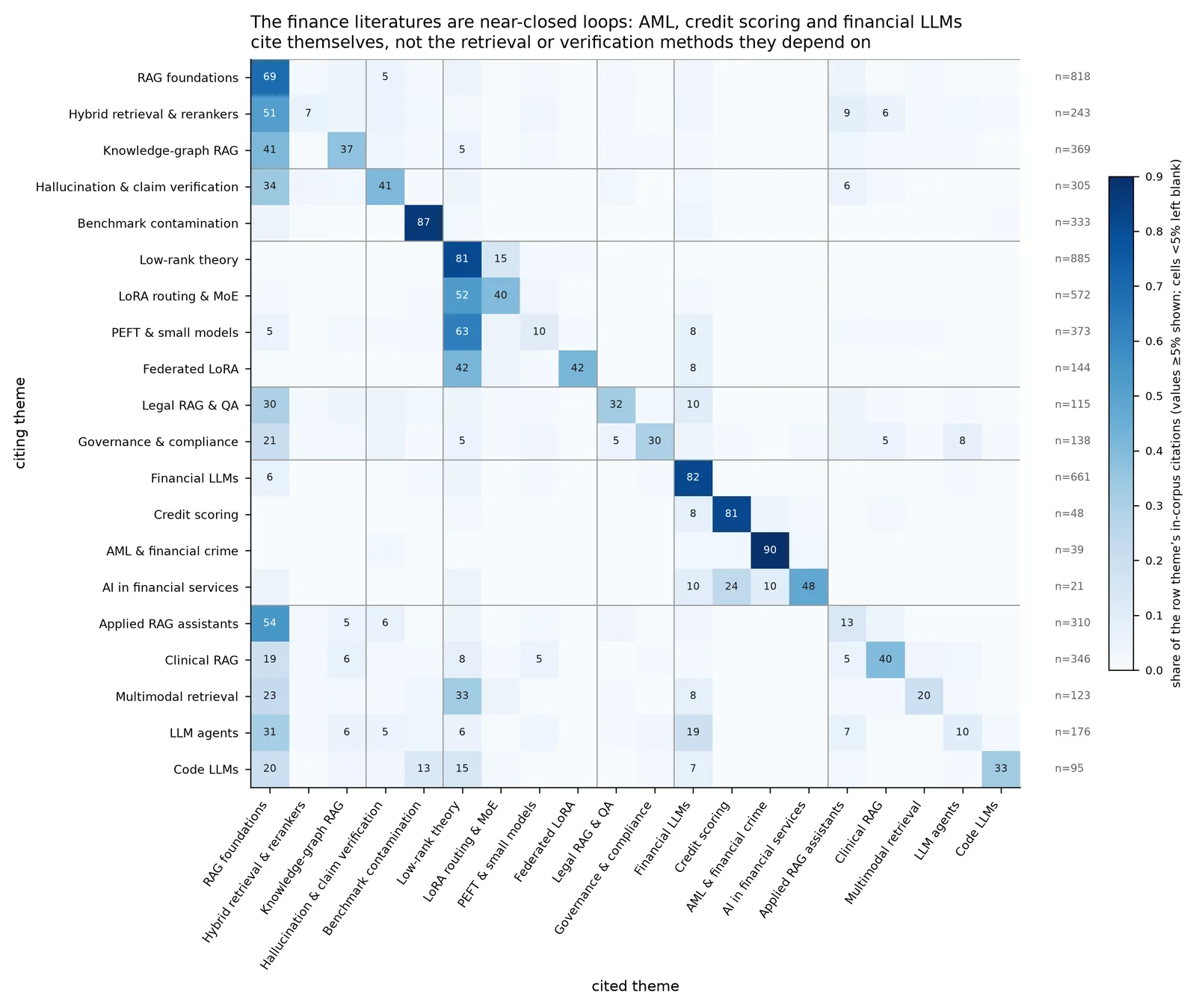
Figure 4. Share of each theme’s in-corpus citations by cited theme. The citation graph is the induced subgraph of a topical sample and is deliberately sparse, so read it as relative structure between themes rather than absolute influence.
Finding 3 — assurance properties go unmeasured
We labelled the most-cited 456 papers of the 801-paper finance-or-legal × RAG slice by what each one measures, rather than what it claims. End-task accuracy appears in 71%. Refusal and abstention appear in 2.0%, calibration in 2.2%. Of the 117 papers that retrieve over primary regulatory or statutory text, one measures refusal.
For a compliance team, that ordering is backwards. What a system does when it should not answer is the property that decides whether it can be put in front of an examiner.

Figure 5. What the finance and legal RAG literature measures. Labels are single-pass model annotations over titles and abstracts, with no human-validated sample — reliable for the coarse contrast between 71% and 2%, not for precise rates.
Finding 4 — the named US consumer-finance regulations are nearly untouched
Exact-phrase probes over 2021–2026 separate policy commentary from systems that actually retrieve over regulatory text:
Phrase
Papers 2021–26
LLM-related
RAG or PEFT
“Regulation Z”
13
0
0
“Truth in Lending”
8
0
0
“Regulation E”
72
0
0
“Equal Credit Opportunity”
29
10
0
“Code of Federal Regulations”
218
8
2
“compliance” + “retrieval augmented generation”
615
505
499
The generic compliance-plus-RAG literature is substantial. The specific rules a US lender or credit union answers to are not in it: across all six named-regulation phrases, three papers combine a named regulation with retrieval augmentation or adapter tuning. Phrase probes match titles and abstracts only, so these are lower bounds — and unpublished is not the same as non-existent, since vendors build without publishing.

Figure 3. The citation backbone by citations per year. Only two papers are cited from more than fifteen of the twenty themes; below them the bridges are RAG evaluation instruments.
Limitations
arXiv’s API was unreachable throughout; preprints enter only through Semantic Scholar’s indexing, so very recent preprints may be missing.
2026 is a partial year, through 16 September. Every 2026 rate is annualised and labelled as such.
Cluster boundaries are soft — best silhouette 0.049 — and at least one visible misassignment exists. Assignments are indicative.
The evaluation labels cover 456 of 801 niche papers, and the cut is positional rather than random: the corpus is citation-sorted, so labelled papers skew more-cited and slightly older.
Coverage is query-driven, not exhaustive.
The corpus, the cluster assignments, the annotation labels and the retrieval scripts are available on request. We would rather they were checked.
Research published September 2026. Figures and counts are reproducible from the corpus and scripts described above.